Q&A: Finding the Funny
Our Chicago Dramatists playwrights and teachers discuss their craft and share inspiration and advice on a host of topics. Columns originally appeared in the Chicago Dramatists newsletter and are edited here for general interest.
Joe Janes on where to find humor and how to get it into your writing
CD: Joe, it's awful out there! Help us: how can we find the funny in our world?
Joe: Michael Gelman--who I’ve had the pleasure of working with at Second City--and I were once discussing making people laugh in areas where we assume people don’t have much to find funny. He said, “Where there’s laughter, there’s hope.” A laugh is a moment of communal enlightenment. I also believe “Joy is a form of resistance.” People in power don’t want you to have a good time, especially at their expense. But your question was how can we find the funny? That’s simple. People in power are usually idiots.
CD: So, there should be a lot of material out there. But how do we get that humor into our work? Can you teach people to be funny?
Joe: Some of the funniest people I know are not very funny in person. They’re funny when they improvise or when they write because (tip alert!) they are being honest and speaking truth. The laughter doesn’t come from snappy dialogue; it comes from relatable human behavior. In my decades of experience teaching at Columbia College and The Second City, I have seen people go from being “not funny” to “funny.” Typically, they stumble upon a laugh while improvising or discover a serious line they wrote for a scene is hilarious. It opens a world for them. They may not be the class clown, but they start creatively playing with the notion that they might actually be funny.
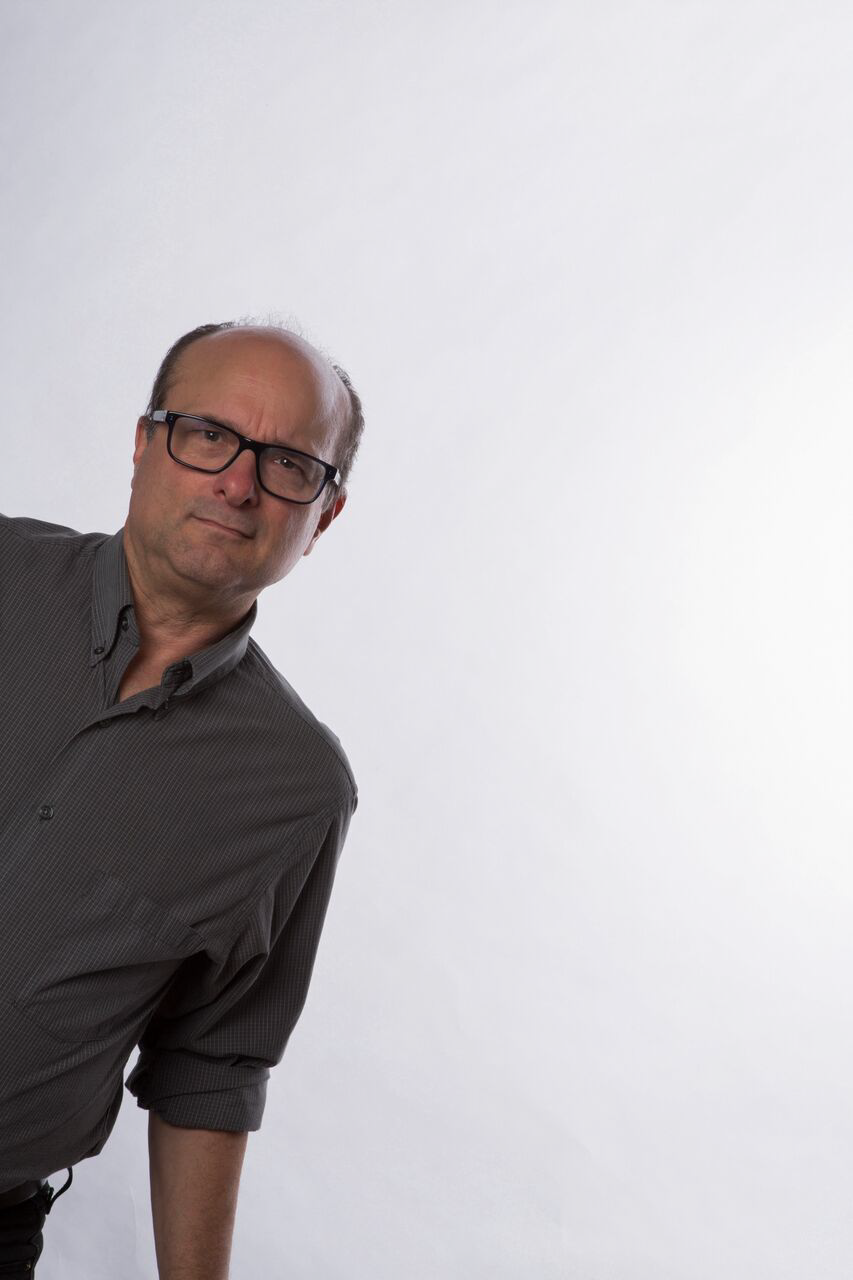
CD: This picture of you makes me laugh out loud. Why are "off-center" things so inherently funny?
Joe: Charlie Chaplin once did an experiment. He took two photos of himself sitting with a bamboo cane. Virtually identical. People were asked which picture they thought was funny and they always picked the same one without being able to point to what the difference was. In the funny photo, the bamboo cane was slightly bowed. My picture is significantly less subtle, but it’s the minor alteration that is unexpected. It’s also an excuse to compare myself with Charlie Chaplin. I’m also taller and would never wear a Hitler mustache.
CD. You've said, "Especially when it comes to using or injecting humor into writing, people tend to wait for a good idea, like they are waiting to be struck by lightning." How do you help people stop waiting for a good idea and, as you say, "go find it."
Joe: Improvisers don’t wait to have something to say before they get up on stage and improvise. Writing is the same. It’s an improvisational act on paper (or screen). I’m a big fan of brainstorming and writing prompts.I can also sit down and write a scene or 10-minute play with a one-word suggestion or title. Thomas Edison said, “Genius is 1% inspiration, 99% (other people’s) perspiration.” I added “other people.” Yes, I have so far compared myself to Charlie Chaplin and Thomas Edison. Mother Teresa is coming up.
CD: When did you know you were funny? How did you turn that into a career?
Joe: I watched a lot of comedies and comedians on TV growing up, and I was fascinated by the mechanics of saying something and then people laughing. In the fourth grade, our teacher let me put up a short sketch comedy show I wrote. It went well and we got laughs! Jump ahead to college, where I started a comedy/improv group and started doing stand-up at a local comedy club. The folks I met at the comedy club convinced me to go on the road, which I did for five years before settling in Chicago and getting back into theater and starting to teach.
CD. You've written several 10-minute plays and many full-length plays. You've also written for SNL's "Weekend Update," and for the video game series "You Don't Know Jack." How do you bring the breadth of what you've learned to benefit classrooms that might be filled with writers working in different mediums?
Joe: What I have learned through all the media I have worked in is that “Brevity is the soul of wit.” What! Shakespeare? I’m shameless in my name-dropping. Fun fact, that Shakes quote is from Hamlet which, when done in its entirety, is four hours long! As a playwright, I overwrite and always need to chop things for clarity, which also strengthens the material, usually making it funnier. Hamlet would have been a great comedy if it were shorter.
CD: I expect your students will spend a lot of time laughing. Should they take Finding the Funny just so they can laugh for three hours a week? Will they actually have to do any writing?
Joe: Both things are true! Class will be a soul-nourishing break from the madness of the world. You’ll hang out with some like-minded creative folk who make the planet a better place just by being around. And, yes, we will write in this writing class. As Mother Teresa once said, “Quit yer b*tching and get writing!”